
Essential Hospital Doors And Their Technical Specifications
Doors used in hospitals play a crucial role in ensuring efficient healthcare delivery as well as maintaining hygiene and safety standards. Hospital door standards are tailored to meet the specific needs of different departments and are supported by detailed technical specifications. These doors contribute to infection control, accessibility, and fire safety through their material quality, size standards, and functional features. Options such as laminate hospital doors, aluminum frame hospital doors, and steel frame hospital doors are selected based on durability and application areas. Technical specifications provide comprehensive information ranging from door dimensions and material properties to installation details and maintenance requirements. This article explores the essential features, measurement standards, and technical specifications of hospital doors in detail, offering an in-depth understanding of their technical demands and industry practices in healthcare facilities.
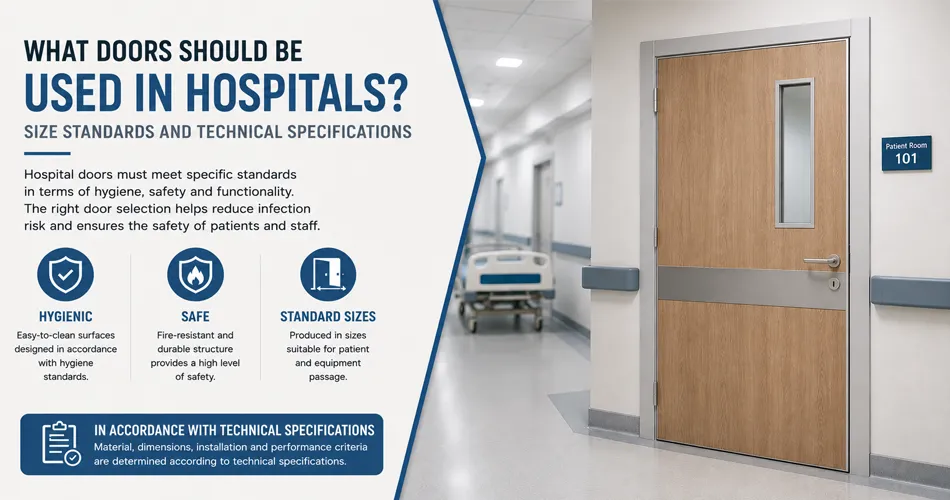
Selecting the right doors for hospitals is vital for maintaining hygiene, safety, and functionality in healthcare environments. Proper door choices ensure the safety of patients and staff while minimizing infection risks. Therefore, hospital door standards and technical specifications are established to meet the sector’s requirements.
These standards vary according to door dimensions, material composition, durability, and intended use. The technical features of doors are designed to address the distinct needs of various hospital areas. For example, operating room doors differ significantly from patient room doors. This article provides a detailed examination of hospital door types, measurement standards, and technical specifications.
Which Doors Should Hospitals Have? Measurement Standards and Technical Specifications
The Importance of Hospital Door Standards
Hospital door standards are developed to ensure hygiene, safety, and ease of use within healthcare facilities. These standards define the material quality, dimensions, and technical characteristics of doors, supporting infection control in hospital settings. They also facilitate quick and safe evacuation during emergencies.
By enhancing door durability, these standards extend service life, creating a safer environment for hospital staff and patients. Technical specifications detail installation, maintenance needs, and performance criteria to ensure compliance during implementation.
Types of Hospital Doors and Material Features
Hospital doors are manufactured from various materials, each suited to specific applications. Laminate hospital doors are favored in patient rooms and clinics for their aesthetic appeal and easy-to-clean surfaces. Their hygienic design helps reduce infection risks.
Aluminum frame hospital doors offer lightweight durability, making them ideal for high-traffic areas. Aluminum frames resist corrosion and provide long-lasting performance. Steel frame hospital doors are used in areas requiring high durability, such as emergency rooms and technical sections.
Hospital Door Measurement Standards
Door size standards vary based on their intended function. Generally, door widths range from 90 to 110 cm, and heights between 210 and 220 cm, allowing smooth passage of patient transport equipment. Operating room and emergency exit doors are wider to accommodate stretchers and wheelchairs. Measurement standards also consider door swing direction and mechanical hardware, all detailed in technical specifications.
Contents of Hospital Door Technical Specifications
Technical specifications cover material quality, dimensions, installation procedures, and performance benchmarks. They include fire resistance ratings, sound insulation, hygienic surface properties, and ease of use. Door accessories and locking mechanisms are also specified.
Installation timelines and maintenance requirements are clearly defined to ensure long-lasting, safe operation. These specifications serve as a common reference point for hospital management and suppliers.
Technical Features of Laminate Hospital Doors
Laminate doors use high-pressure laminate surface coatings that resist scratches and chemical cleaners. They provide hygienic, easy-to-clean surfaces. Door cores are typically steel or MDF. Specifications outline door thickness, edge banding, and installation details. Fire resistance and sound insulation must meet standards. Laminate doors are ideal for patient rooms and clinics.
Features of Aluminum Frame Hospital Doors
Aluminum frame doors are lightweight and durable, suited for hospital corridors and busy areas. Aluminum frames resist corrosion and have a long lifespan. Door panels are usually aluminum or composite materials.
Specifications include profile dimensions, surface finish options, and installation details. Opening mechanisms and locking systems must comply with standards. Aluminum frame doors combine aesthetics with functionality.
Applications of Steel Frame Hospital Doors
Steel frame hospital doors are used in areas requiring high durability, such as technical service rooms, emergency entrances, and storage areas. Steel frames withstand mechanical impacts and offer longevity.
Specifications detail frame thickness, door panel materials, and surface treatments. Fire resistance and security features are also specified. Steel frame doors support the structural integrity and safety of hospital infrastructure.
When selecting hospital doors, the requirements of the usage area, material properties, and technical standards are paramount. Laminate, aluminum frame, and steel frame doors provide tailored solutions for different needs. Measurement standards and technical specifications ensure doors are safe, hygienic, and functional. Using doors that meet these criteria is critical for patient comfort and staff safety in healthcare facilities.
İlgili Ürünler

Arma Glass and Slatted Apartment Steel Door

Obsidian Gray Hospital Door with Kick Plate and Stretcher
Moderna Tiffany Card Lock Hotel Door Handle

Red Calla Lily Glass and Stretcher-Compatible Laminated Hospital Room Door

Boa Vista Teak Hospital Door with Kick Plate and Stretcher

Bells Of Ireland Metal-Framed and Kick Plate Laminated Door

Ado Door Model 106 Hall Door One and Half Leaf

Compact Laminate Wc Doors

Palandoken Melamine Room Door without Glass

Palandoken Four Glass Melamine Room Door
- Blog Comments
